
The Hand That Thinks
Complexity, causality and the gap nobody manages

Most critiques of complexity frameworks stop at the critique. This one tries to go further.
It begins with an epistemological problem, the way our frameworks for navigating complexity smuggle in the very assumptions they claim to challenge and traces that problem to something more practical and more urgent: the gap between the organising logic that keeps a system viable and the structural reality through which that logic must be realised. Almost nobody manages that gap. Almost every methodology pretends it doesn’t exist. And the cost of leaving it unoccupied is paid quietly, continuously, in the slow incoherence of organisations that move without knowing why and stop without knowing what is failing.
What follows is part critique, part reframing and part signal of a direction of travel. The hand in the subsequent image is a thinking system. So, I am arguing, is any viable organisation and the work of keeping organisation and structure in continuous, productive relationship is the work that most frameworks hand off, walk away from, and call complete. It isn’t.
The Problem With Senge
There’s a famous line from Peter Senge: cause and effect are not closely related in time and space. It’s meant to dislodge you from naive, linear thinking. And it does. A little.
“Cause and effect are not closely related in time and space” - Peter Senge, The Fifth Discipline
But here’s the problem we aren’t surfacing: the statement is self-defeating.
To say cause and effect are “not closely related” still assumes there are causes, there are effects, and they have a relationship you can observe from the outside. Senge is using the reductive model to critique the reductive model. With this phrase, he’s stretching linear causality, not replacing it, or truly contrasting it.
We can perhaps put this down to grammar does it to you.
Subject → verb → object
Agent → action → outcome
Western language structures encode linear causality at the syntactic level, which means the moment you try to describe circular, co-constitutive dynamics, the medium betrays the message. Senge wasn't careless. The Fifth Discipline was remarkable in bringing Systems Dynamics and a version of Systems Practice to the mainstream. I suggest he was trapped by the conceptual furniture of the tradition he was trying to move beyond.
I suggest he was trapped by the conceptual furniture of the tradition he was trying to move beyond.
But here is what I think matters most: the juxtaposition of linear versus circular thinking is the point, and that is where the pragmatic value lies. Not in the escape from one to the other. Holding the tension between them, without collapsing it prematurely into a resolution, is the more honest and more useful position.
Cynefin: Genuine Contribution, Unresolved Tension
The same tension runs through Cynefin, the influential framework developed by Dave Snowden, though it deserves a more careful reading than it usually gets, in both directions.
Cynefin’s core move is important. Rather than offering yet another framework claiming universal applicability, it distinguishes types of situation by the nature of their causality and assigns different responses accordingly. It explicitly licenses safe-to-fail experiments as legitimate management practice rather than a failure of analysis. It names the costly failure mode of applying ordered tools to unordered situations. And it recognises that over constraining a complex system doesn’t make it more ordered, it can tip it into chaos. More control does not equal more order in unordered domains. These are genuine contributions.
As a related aside, this mismatch between the type of system being managed and the type of model being used to manage it was described by Ackoff and Gharajedaghi as early as 1985, though they classified systems not by causality but by whether their parts and the whole display choice. The question of fit between model and situation has a longer lineage than Cynefin's framing suggests.
Back to Cynefin, Greg Brougham’s careful reading identifies at least three distinct uses that practitioners tend to collapse into one:
Categorisation - sorting situations by the type of causality at work. This is where most people stop, treating Cynefin as a sorting device. It is useful. It is also the most reductive use.
Contextualisation - using the framework not to sort once but to situate ongoing practice. Which methods belong here? What governance is appropriate? What counts as evidence in this domain? This is richer, it makes the framework relational rather than taxonomic.
Dynamic - attending to how situations move between domains, how constraints shift, how systems tip. This is Cynefin at its most generative: not a map of fixed territories but a sensitivity to transitions and thresholds. Though even here, the dynamics of situation and observer are treated as separate, the framework attends to one without attending to the other.
Brougham also surfaces an important tension the framework itself acknowledges but doesn’t resolve. The disorder domain - the condition of not knowing which domain you’re in, is recognised as an inauthentic classification, one that sense-making moves toward correcting without ever fully achieving it. That admission is significant. It concedes that the framework’s starting condition is misclassification, not clarity.
And yet even at its most dynamic, Cynefin preserves cause and effect as the fundamental ontology. It varies how visible that relationship is, not whether the relationship is the right way to think. Even in the complex domain, the prescribed logic is probe, sense, respond, still a linear epistemology applied to what is actually a circular phenomenon. The framework positions you as an observer standing outside the system, diagnosing which domain you’re in. But that position doesn’t exist.
Your act of categorising the situation is itself an intervention. It changes what people attend to, what feels actionable, what gets ignored. The diagnosis is part of the dynamic.
Your act of categorising the situation is itself an intervention.
Again: the juxtaposition is the point. The value is not in resolving linear and circular - it is in learning to hold them together without collapsing into either.
What Circular Causality Actually Means
In genuinely complex systems, cause and effect aren’t distant, they’re circular. Effects feed back and become causes. There is no clean origin point. The question “what caused this?” already smuggles in assumptions: that there is a cause, that it is locatable, that it is separable from its effects, and that you are separate from the system well enough to find it.
Before that question is even asked, a prior and more consequential move has already been made: the boundary. What is inside the system and what is outside it. What counts as relevant and what gets ignored. That boundary is not given by the situation. It is drawn by the observer and it determines what can possibly appear as cause or effect within it. Ulrich’s Critical Systems Heuristics makes this precise: every systems design, every intervention, every diagnosis embeds boundary judgements that privilege some interests, some variables, some timescales over others. To critique a causal claim is, at root, to critique a boundary choice.
This connects directly to Gell-Mann’s point, developed later: complexity is a relational quantity, existing between a system and a describing observer at a given level of coarse graining. Change the boundary, change the grain, and you change what the system is and what counts as causing what within it.
The honest version of what Senge was reaching for sounds something like:
the question “what caused this?” is itself part of what’s producing the dynamic you’re trying to understand.
Which is uncomfortable. Because it dissolves the handle you thought you had on the situation.
Most frameworks stop just short of that conclusion and I have some sympathy for why. A genuinely circular epistemology, one that refuses to separate the map from the mapmaker, is almost impossible to package and sell. So practitioners compress it. They draw the box, the wiggly lines, even collectively, they name the domains. They give you something to do on Monday morning. The complexity gets laundered into something teachable. Something a consultant can deliver.
Cynefin is not alone in this. Michael C. Jackson's Critical Systems Practice (CSP) goes further still, advocating multi-paradigm, multi-methodology, and multi-method engagement grounded in the System of Systems Methodologies (SOSM) framework, which maps systems approaches against both problem complexity and the nature of stakeholder relations, including coercion. It is a genuine and important advance, philosophically rigorous in a way that many pluralist frameworks are not, and one that practitioners would do well to take seriously. But even the most sophisticated pluralism, when organised as a process of methodological selection, leaves one question insufficiently examined: what kind of observer is doing the selecting, and how does that shape what they perceive as the problem in the first place and how it unfolds as the situation develops and the observer moves within it?
Three Reframings, Offered in a Pragmatist Spirit
Here’s what I think is actually going on beneath the surface and what these frameworks consistently miss.
We tend to treat complexity as a property of situations. This thing over here is simple. That thing over there is complex. We sort, we categorise, we pick the right tool for the right domain. The demarcation between simple, complicated, and complex is useful but it misleads us in a specific way: it conflates ontology, epistemology, and practice as though they were one question. They aren’t.
Three provisional statements, not offered as truth, but as more useful orientations. The test is not whether they are correct, but what they make possible:
Start with relationships and things emerge - Ontology. The world is not made of things with properties. It is made of relationships from which things appear to emerge. Entities are not primary; interactions are. This is not mysticism. It is what complexity science actually shows us.
Complexity is not a property, it’s a relationship - Epistemology. A situation is not complex in itself. It is complex relative to an observer, their models, their assumptions, their attentional habits, their tolerance for ambiguity. Change the observer and you change the complexity.
Complexity is in the eye of the beholder - Practice. Which means the practitioner is always part of the equation. You cannot diagnose the situation without diagnosing yourself. The assessment is never neutral.
Taken together: complexity is a property of the relationship between the situation and the observer. Not the situation alone.
Gell-Mann and the Co-Generating Loop
This aligns with something Murray Gell-Mann argued that doesn’t get nearly enough attention outside physics and biology.
Simplicity and complexity are not opposites. They are co-generating partners.
Simple fundamental laws, acting through quantum randomness and chaos, produce an immense space of possible histories. Selection, at every level from physics to biology to culture, picks out which regularities survive and persist. Complexity is not a property of the stuff itself, nor of our ignorance about it. It is a relational quantity: it exists between a system and a describing observer, at a given level of coarse graining. Change the observer, change the grain, and you change what counts as complex.
This is Gell-Mann’s most underappreciated move and it lands directly on the argument being made here. Complexity is not out there waiting to be discovered. It is produced in the relationship between what is observed and who is observing.
Complex Adaptive Systems (CAS): biological, organisational, cultural, historical, the jaguar, enact this loop whether they know it or not. In organisations, the question is whether they do so with enough awareness to learn from it. They acquire information about their environment, identify regularities, compress those regularities into a schema, a working model of the world, and act on the basis of that schema. The consequences of that action feed back as selection pressure on the schema itself. The model shapes behaviour; behaviour shapes the environment; the environment reshapes the model, that is, structural coupling in action.
Which means sense-making doesn’t just clarify the situation.
It develops the observer.
Which changes what they see.
Which changes what methodology fits.
Which develops them further and so on.
The frameworks and the practitioner co-evolve and that loop is exactly what most classification frameworks miss. Jackson's SOSM comes closest: its columns explicitly recognise that human complexity and coercion shape which methodology is appropriate. But recognising people as a dimension of the situation is not the same as asking how the observer's own development shapes what they are able to see as the situation in the first place. The SOSM accounts for people. It does not account for the practitioner perceiving them or for how that perception shifts as the situation unfolds and the observer develops within it. The observer is not a neutral instrument. The observer is in the loop. And this, stated in complexity science terms, is pragmatism: the schema is not judged by its correspondence to reality, but by the quality of action it enables and the feedback it generates.
The schema is not judged by its correspondence to reality, but by the quality of action it enables and the feedback it generates.
The Hand That Thinks: Organisation and Structure and the Gap Between Them
There is a distinction that I think is fundamental to practice, and that few methodologies makes explicit. Raul Espejo is a notable exception, working directly from the ground laid by Maturana and Varela, whose distinction between Organisation and Structure in living systems remains one of the most consequential and least absorbed ideas in contemporary science. Martin Pfiffner makes the same distinction in the Neurology of Business, grounding it in the lived reality of organisations rather than biological systems. Jackson describes it elegantly in his own terms. The intellectual recognition is there, scattered across the literature.
And yet no methodology has aligned it into contemporary practice in a way that holds.
What we have instead is a slow collision. Organising Models e.g. VSM, SSM, CSH etc are tip-toeing toward structural realisation without a principled way of getting there. Meanwhile contemporary management and technical practices - Enterprise Architecture, Agile, Organisational Design, are reaching backwards, trying to ground themselves in theory on the fly, borrowing concepts they haven’t fully absorbed and applying them to problems they haven’t fully framed. Neither side has a methodology that occupies the space between them and holds it. We are, to borrow a phrase from my Sheffield upbringing, ending up in a right muddle.
We are, to borrow a phrase from my Sheffield upbringing, ending up in a right muddle.
The distinction itself is this: Organisation is the set of relations that must be present for a system to be what it is, its identity, its invariant logic, its pattern of viability. Structure is the specific physical and social realisation of that organisation at any given moment, plastic, changeable, always particular. A cell can replace every molecule it contains and remain the same cell, because its organisation persists through structural change. Destroy the organisation and the system ceases to be what it was, regardless of what the structure looks like.
Maturana and Varela developed this in the context of biological autopoiesis. Espejo, working in the tradition of Beer’s Viable System Model, extended it into organisational cybernetics but didn’t go far enough in my humble opinion. The implication for management and design practice remains profound and largely ignored.
In practice the distinction gives us two fundamentally different kinds of model and a largely unoccupied space between them.
Organising models are neurological. They describe the invariant relational architecture that any viable system must instantiate, the regulatory logic that keeps a system coherent, adaptive, and purposeful over time. Stafford Beer’s Viable System Model is the most rigorous of these. Checkland’s Soft Systems Methodology and Ulrich’s Critical Systems Heuristics belong here too. They do not tell you what your organisation should look like. They tell you what conditions must be present for any organisation to remain viable at all. They are models of organisation as a process, not organisation as a thing.
Structural models encompass both anatomy and physiology, the arrangements of the organisation and how those arrangements function and flow. Contemporary IT Enterprise Architecture, Organisational Design, Solution Architecture, Business Process Management (BPM), Agile delivery frameworks, these are all structural models. They describe what the organisation is built from and how it operates moment to moment. They are essential. But they are plastic, and they have no intrinsic theory of what shape they should take or why. They are answers waiting for a question most of them never ask: what does the organising logic require of the structure?
I believe Kauffman's work on Constraint Closure gives this distinction its scientific teeth. Once a system achieves sufficient organisation, what Kauffman calls autocatalytic closure, the whole becomes a requirement for the parts, not merely a result of them. Causation runs both ways simultaneously. Which is what I mean by middle-out architecture, neither bottom-up only, not top-down. This is the scientific justification for why organising models cannot be derived from structural ones. The river is not made of the water. Remove the river and the water disperses. Remove the organisation and the structure dissolves into components that share a name but no longer constitute a system. This is also why the two failure modes are symmetrical:
over-engineered organising becomes a cage - the river stops flowing and local adaptation dies.
Under-engineered structure means constraint closure fails - the Kantian whole dissolves, and what remains is a collection of siloed activities that share a name but no longer constitute a system
The gap between what the neurology demands and what the structure delivers is where most organisational transformation fails.
The gap between what the neurology demands and what the structure delivers is where most organisational transformation fails
But here is the part that is almost never named: the failure is not just intellectual. It is procedural. Consultancy engages pluralistically - it surfaces competing worldviews, holds complexity open, nudges toward coherence. Then it hands over to IT delivery, which imposes a unitary system. The variety the diagnosis revealed is collapsed at precisely the moment it most needs to be preserved. The mediating intelligence disappears. What remains is a structure that reflects the organising logic of the delivery methodology, not the organising logic of the organisation.
The variety the diagnosis revealed is collapsed at precisely the moment it most needs to be preserved
This is not a failure of execution. It is a failure of continuity. The mediation between Organising model and Structural model cannot be a one-off exercise. It must be perpetual, an ongoing practice of holding the two in productive tension as the environment shifts, as the structure evolves, as the organisation learns. What is needed is not better consultancy followed by better delivery. What is needed is a methodology that occupies the space between them permanently, and makes the relationship between organising logic and structural realisation legible and manageable in real time.
The Viable Operating Model, the work I have been developing over a number of years, and which I also hope to pursue at doctoral level, is an attempt to build exactly that mediating framework. Not a project. Not an intervention. A practice.
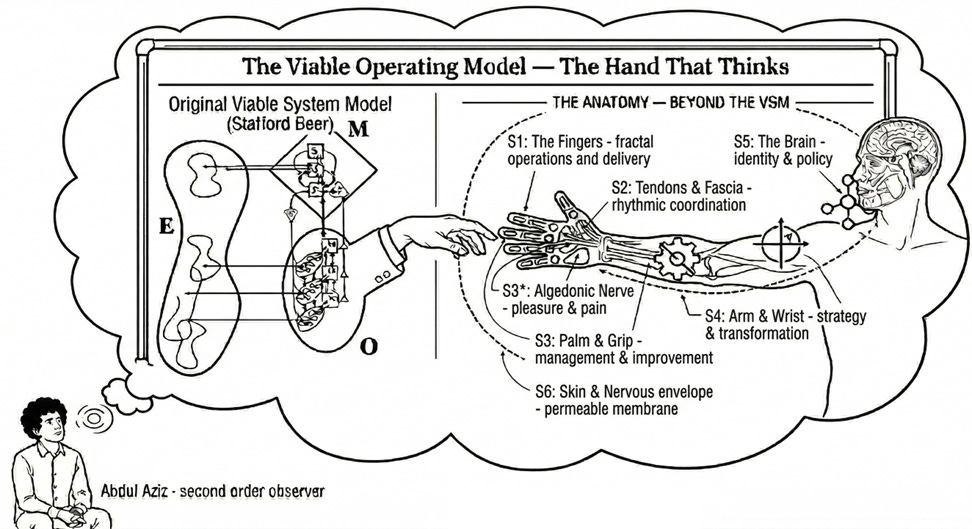
The hand is not decorative. It is a viable system. The fingers deliver, fractal, operational, where value is actually created (VSM System 1). The palm grips, Management and Improvement (VSM System 3), keeping things aligned today. The wrist and arm reach - Strategy and Transformation, orienting toward what is next (VSM System 4). The brain holds identity and policy, the purpose that orients the whole without micromanaging any of it (VSM System 5). The algedonic nerve bypasses deliberation when a threshold is crossed (S3*). The Organisation and Structure in continuous, mutual regulation. That is what viability looks like.
The Viability Cross, as I am terming it, makes the core tension explicit across two axes.
The first is Grip versus Reach. System 3, management and improvement, must be in constant negotiation with System 4, strategy and transformation. Too much grip and the organisation rigidifies, optimising a world that is already changing. Too much reach and it loses coherence, pursuing futures it cannot structurally sustain.
The second is Promise versus Proof. System 5 - what the organisation stands for, its identity and policy - must stay connected to System 1, where value is actually created and experienced. When they disconnect you get rhetoric or drift. Usually both.
These are not four separate dials. They are two live tensions, held simultaneously. That is the cross.
This maps onto Beer’s Triple Index. Improvement is the movement from Actuality toward Capability - from proof toward grip. Transformation is the movement from Capability toward Potentiality, from grip toward reach, guided by promise. The practical problem is that System 3 is very strong. It pulls reach back into grip. Most transformation gets quietly absorbed into improvement before it takes hold. “All improvement requires change, but not all change is improvement”. The viable cross makes that distinction visible in a way most frameworks cannot.
Beer gave us the neurological architecture. What remains is to give it structural content and read the relationship between them continuously in real time. That is the role of the Systemic Performance Surface (SPS), not a dashboard, not a scorecard, but a live dual reading: structural performance on one side, organising health on the other, with the gap between them named as system state. The instrument that makes perpetual mediation operational. What turns the model from a framework you think about into a surface you practise on, every day.
More on all of this as it develops. The intent here is simply to name the problem clearly enough that the direction of travel makes sense.
A Better Question
So the question shifts.
Stop asking: what kind of situation is this?
Start asking: what is the relationship between this situation and this observer — and how do we develop both?
Not just complexify the model. Complexify ourselves. Develop the reflexivity, the attentional range, the epistemic humility that the situation is actually demanding.
Most professional development treats the practitioner as a pipeline for better tools and frameworks. But if the observer is constitutive of what complexity is, then developing the observer is not a soft, supplementary concern. It is the work.
And if the frameworks we use to develop observers are themselves reductive, if they treat the practitioner as standing outside the system, applying the right tool to the right domain, then we need frameworks designed differently. Built from the organising logic out. Held accountable by a live reading of both the structure they shape and the neurology they serve. Designed not just to describe viable systems, but to develop the people inside them.
This appears to be the edge I am traversing. The hand that thinks is not the framework. It is the person holding it.
Further Reading
Waldrop, M. (1992) Complexity: The Emerging Science at the Edge of Order and Chaos
Gell-Mann, M. (1995) The Quark and the Jaguar
Beer, S. (1985) Brain of the Firm
Maturana, H. and Varela, F. (1987) The Tree of Knowledge
Checkland, P. (1981) Systems Thinking, Systems Practice
Pfiffner, M. (2020) The Neurology of Business
Ackoff, R. (1981) Creating the Corporate Future
Brougham, G. (2015) The Cynefin Mini Book
Jackson, M. (2019) Critical Systems Thinking and the Management of Complexity
Jackson, M. (2024) Critical Systems Thinking: A Practitioner’s Guide
Kauffman, S. (1995) At Home in the Universe: The Search for the Laws of Self-Organisation and Complexity